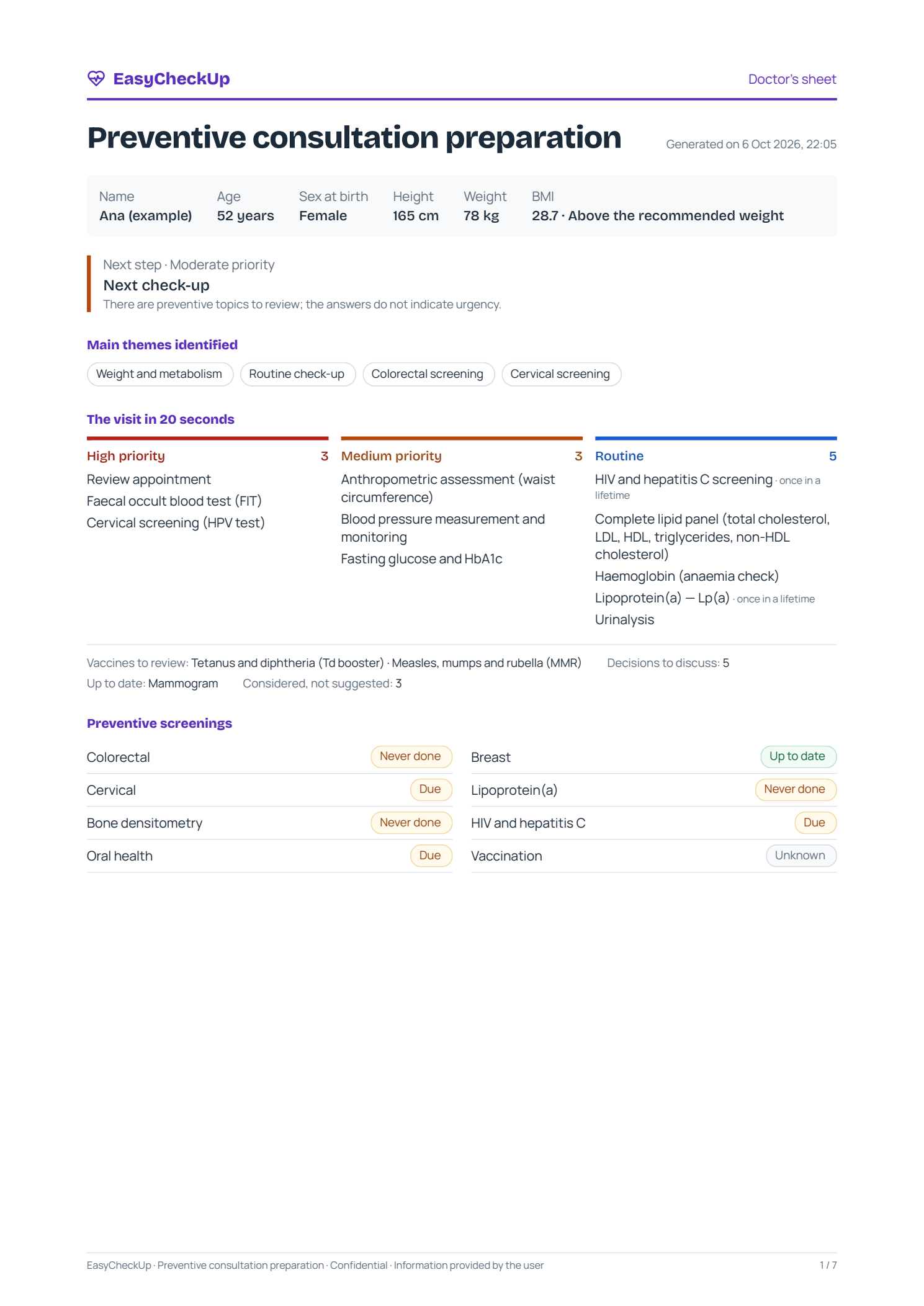
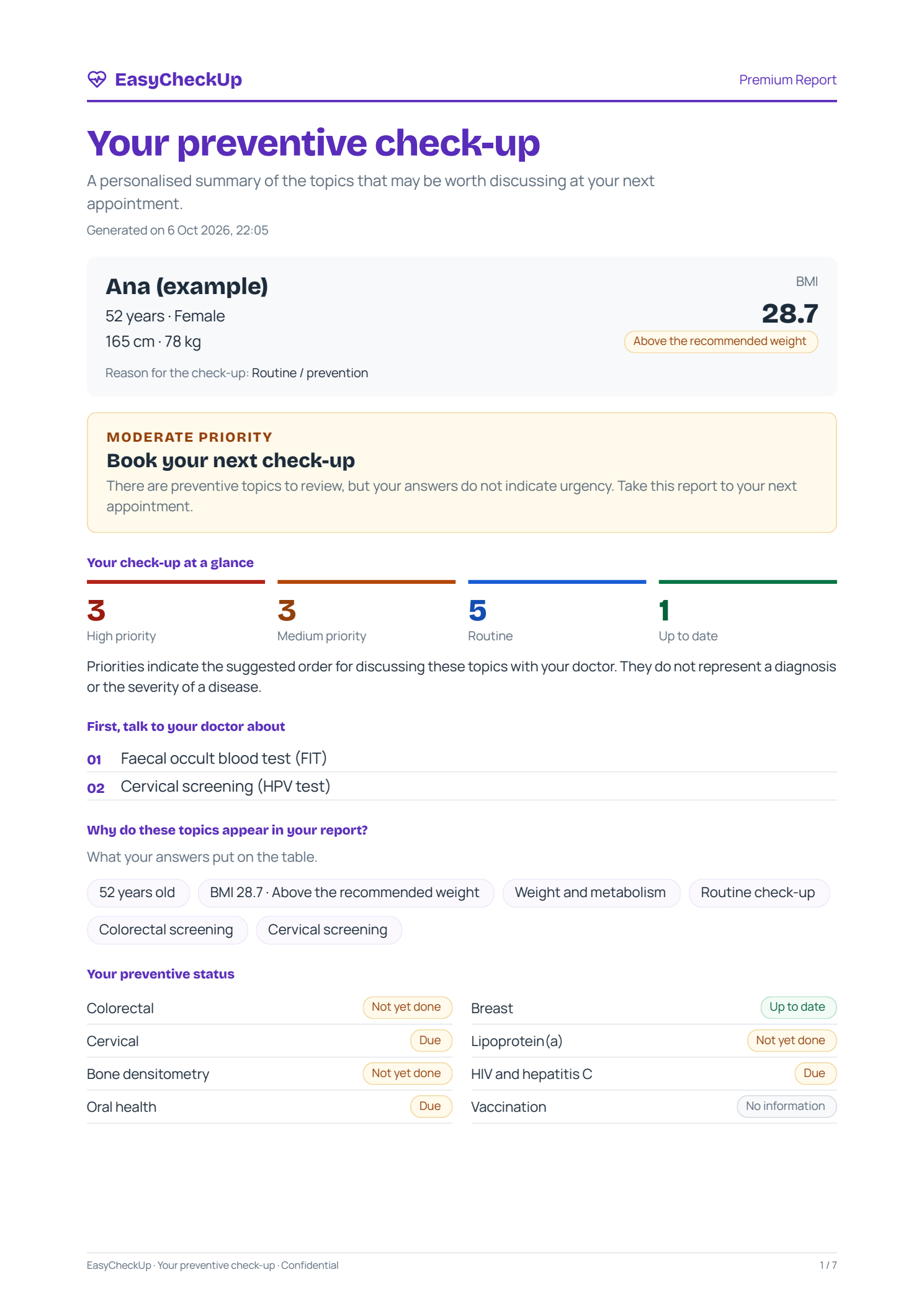
This is exactly what you receive — with nothing held back.
Ana does not exist. Her answers are invented and live in our source code: no real person's report is ever published here. Everything below was computed by the same engines that analyse your own check-up.
MODERATE PRIORITY
Book your next routine appointment
There are topics to review, without urgency. Take the report to the appointment.
Ana (example)
Age
52 years
Sex
Female
Height
165 cm
Weight
78 kg
BMI
28.7
Overweight
BMI = weight ÷ height² (kg/m²)
Tests and exams to discuss with your doctor
The review appointment, if it is due now; the base of the check-up for your age and sex; and what your answers add. Only your doctor can assess the need and order them.
3High
3Medium
5Routine
1Up to date
The review appointment
It is the check-up itself: measuring blood pressure, weight and waist; talking about smoking, alcohol and mood; reviewing vaccines. The rest of the plan is requested from it.
With your doctor
An appointment with your family or regular doctor.
Review appointment with your doctor
Recommended to validate with your doctor
From 40, the DGS norm asks for blood pressure to be checked every year. That same appointment is where weight, waist, habits and vaccines are reviewed, and screenings brought up to date. From 65, the European Society of Cardiology recommends that the heart rhythm is also checked (the pulse, confirmed by an ECG if it is irregular), to detect atrial fibrillation early.
What is suggested to anyone of your age and sex, given the tests you have already had. It is the base of the check-up.
Blood tests
A single blood draw covers all of these tests at once.
Fasting glucose and HbA1c
To consider with your doctor
Discuss the interval
From age 35, periodic blood-sugar assessment is part of the preventive check-up.
You indicated that your last check-up was more than two years ago.
The BMI calculated from your measurements suggests value in assessing your metabolic profile.
Between 35 and 70, with excess weight, diabetes screening is recommended even without symptoms — it is where the American and European guidelines agree.
We recommend discussing with your doctor how often this exam should be repeated.
The Portuguese diabetes care pathway (DGS, 2013) starts with a risk questionnaire and only asks for the test when the score is high; the ADA proposes the test for everyone from age 35.
HIV and hepatitis C screening
Routine
The Portuguese norm offers these two tests to every adult at least once — not because of any suspicion, but because these infections can go years without a sign and are treatable today.
Includes: HIV 1/2 (Ag/Ab) · Hepatitis C — anti-HCV
Once in adult life — repeated only if there has been a risk exposure
The Portuguese cardiovascular risk guideline (DGS 005/2013, updated in 2025) follows this European guideline and uses the same SCORE2 charts; we cite the original.
Haemoglobin (anaemia check)
Routine
From age 50, a simple test shows whether you are anaemic, which is often silent. It is not screening that guidelines recommend for everyone this age: some national check-up programmes include it, and it is for you and your doctor to decide.
No guideline recommends this test routinely from age 50; South Korea's national check-up programme was the only authority found that includes it. For people who still menstruate, the reference is the United States (CDC), because there is no Portuguese guideline on anaemia screening.
Lipoprotein(a) — Lp(a)
Routine
Lp(a) is genetically determined, does not change over a lifetime and is measured only once. European guidelines say every adult should know it at least once — in Portugal the national norm reserves it for those near the decision threshold, so this suggestion is based on international guidelines.
Once in adult life — the level is genetic and does not change
The Portuguese guideline (DGS 005/2013) only considers it for people close to a risk decision threshold; the ESC/EAS proposes measuring it once in a lifetime in every adult.
Urine tests
A single urine sample is enough for these tests.
Urinalysis
Routine
From age 50, some national check-up programmes include a urinalysis, a dipstick test that can show sugar, blood or protein in the urine. It is not screening that guidelines recommend for everyone this age, and it does not replace the proper kidney test (albumin in the urine) or the blood-sugar test, which are ordered when there is a reason. It is for you and your doctor to decide.
No graded guideline recommends this test routinely; Germany's public periodic check-up includes it for the same purpose: looking for signs of diabetes and kidney disease.
Stool sample
Done at home with a simple kit, delivered to the laboratory.
Faecal occult blood test (FIT)
Recommended to validate with your doctor
Based on your answers, colorectal cancer screening is missing or overdue.
Your age is within the range in which colorectal screening is recommended.
Usually every 2 years (screening programme), if normal
Structured screening programmes — your doctor advises the right timing for each.
Cervical screening (HPV test)
Recommended to validate with your doctor
Based on your answers, cervical screening is missing or overdue.
Your age is within the cervical screening programme.
Includes: High-risk HPV · Cervical cytology (Pap)
Usually every 5 years (HPV test), if normal
If your last screening was a negative HPV test less than 5 years ago, it may still be up to date, because the Portuguese national standard (DGS) repeats it after 5 years; please confirm this with your doctor.
The Portuguese national standard (DGS) provides for the HPV-test sample to be taken preferably by a health professional, but also by the person themselves, from the vagina (self-sampling), if they prefer it or have not responded to two consecutive programme invitations. If the result calls for a next step, that step is taken with a health professional.
These exam suggestions are informational and are intended to support the conversation with your doctor. Only your doctor can assess the need for exams and request them.
Vaccination to discuss with your doctor
Based on your age and your answers, these are the vaccines usually recommended in Portugal (National Vaccination Programme and DGS guidance). We do not know which vaccines you have had — check with your doctor whether you are up to date.
You indicated that your vaccination may not be up to date — it is worth taking your vaccination booklet to your next appointment.
Tetanus and diphtheria (Td booster)
The Td booster is recommended for all adults throughout life (PNV) — check with your doctor when you had the last one.
Adults born from 1970 onwards, with no credible history of measles and no record of vaccination, are due one dose of MMR (Portugal's PNV, Table V). The 1970 cut-off is not arbitrary: the 2015/2016 National Serological Survey found 99.6% of those born earlier already immune from having had the disease. We do not know which vaccines you have had — your vaccination record answers this.
One dose if never vaccinated and no history of measles; two doses for women of childbearing age. Your vaccination record shows how many you already have.
These notes are informative and based on the Portuguese National Vaccination Programme. Only your doctor can review your vaccination record and decide on the right vaccination.
Longevity panel
A baseline longevity panel that EasyCheckUp suggests to every adult, to know and follow over time; to be decided with your doctor. It does not point to any problem: these are reference values to follow your health over the years.
HbA1c (glycated haemoglobin)
Already in your plan — medium priority
When: Yearly
Why it is already in your plan: From age 35, periodic blood-sugar assessment is part of the preventive check-up.
What the sources say: ADA: screening from age 35 and, earlier, with excess weight plus one other risk factor. Below 35, no recommendation for everyone.
High-sensitivity CRP (hs-CRP)
Suggested in the panel — outside your plan
When: Yearly
What the sources say: ESC 2021: not recommended for routine collection (Class III B); ESC/EAS 2025: a modifier to consider from 40 to 89 at moderate risk (Class IIa B). No routine recommendation for everyone.
Ferritin
Suggested in the panel — outside your plan
When: Yearly
What the sources say: DGS 030/2013: diagnostic pathway when there are signs of anaemia or iron deficiency. No source read recommends screening everyone.
TSH and free T4
Suggested in the panel — outside your plan
Includes: TSH, Free T4 (FT4)
When: Yearly
What the sources say: DGS 039/2011: testing when there are clinical signs, medicines, weight change, autoimmune disease or arrhythmia; USPSTF: screening people without symptoms has insufficient evidence (I). No routine recommendation for everyone. Free T4 is included by panel decision.
Apolipoprotein B (ApoB)
Suggested in the panel — outside your plan
When: Yearly
What the sources say: ESC/EAS: recommended in defined populations (high triglycerides, diabetes, obesity, metabolic syndrome, very low LDL). No recommendation for everyone.
Lipoprotein(a) — Lp(a)
Already in your plan — routine
When: Once in adult life
Why it is already in your plan: Lp(a) is genetically determined, does not change over a lifetime and is measured only once. European guidelines say every adult should know it at least once — in Portugal the national norm reserves it for those near the decision threshold, so this suggestion is based on international guidelines.
What the sources say: ESC/EAS 2019: measure at least once in adult life, in all adults (Class IIa, level C).
Liver function
Suggested in the panel — outside your plan
Includes: ALT, AST, GGT
When: Yearly
What the sources say: EASL–EASD–EASO 2024: case-finding in people with metabolic risk or alcohol use; screening the whole population is advised against.
Kidney function
Suggested in the panel — outside your plan
Includes: Creatinine, Estimated GFR (eGFR)
When: Yearly
What the sources say: KDIGO 2024: in people with a risk factor (hypertension, diabetes, cardiovascular disease); without one, low pre-test probability. NICE NG203 (1.1.24): age alone is not a risk factor.
This section is an EasyCheckUp proposal and does not come from a screening guideline for the whole population. That is why it sits apart from your plan and does not change any of the priorities above.
And as PDF, two documents
The same report, written for two readers: the doctor's sheet, with the summary on the first page and the detail after it, and yours, so you arrive knowing what you want to decide. One payment, both files.
Illustrative example, with fictional data.
Yours will be about you
Five minutes. You learn what makes sense to talk through with your doctor. Your answers are not stored.